|
|
|
|
Editor's Note
Dear Readers,
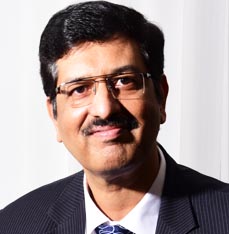
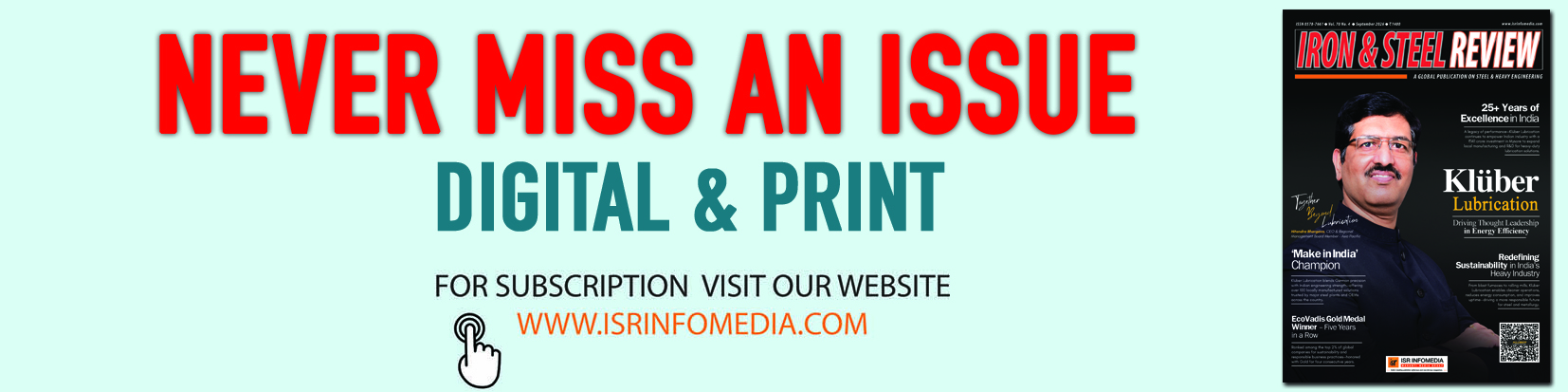
The September newsletter of Iron & Steel Review features an exclusive interview with Hitendra Bhargava, CEO and Member of the Regional Management Board for Asia Pacific. In this insightful conversation, Bhargava delves into the evolving landscape of India’s heavy industries, emphasising Klüber Lubrication’s role in championing sustainable industrial development through innovative lubrication solutions.
India’s infrastructure strategy is evolving. Instead of just building new assets, the focus is now on preserving and sustaining what we have. A study from Nomura Research Institute reveals that corrosion costs the sector a whopping Rs. 1.42 Lakh Crores every year — about 2.9% of its GDP. By using more galvanised steel, we could potentially save up to Rs. 49,580 Crores annually. Let’s prioritise longevity in our infrastructure. For more insights, check out our September newsletter.
On the domestic front, SAIL has partnered with BCCL to jointly develop and operate two coal blocks in West Bengal, aimed at bolstering the availability of raw materials for the steel industry. In international news, Primetals Technologies and voestalpine celebrated a major milestone with the supply and implementation of an EAF Ultimate electric arc furnace at voestalpine’s Linz site in Austria.
Stay informed and updated by reading our full September newsletter! Santosh Mahanti, Editor & CMD |
|
|
“Klüber Lubrication helps customers enhance the performance of critical equipment”
As India’s heavy industries evolve in both scale and intricacy, the focus is shifting from just increasing capacity to optimising the efficient, reliable, and responsible use of that capacity. In sectors such as steel, cement, mining, and power — where equipment operates under challenging conditions and every production hour is critical — prioritising operational reliability, maintenance excellence, and resource efficiency is now essential to enhance competitiveness and promote sustainable growth.
In an interview featured in the September issue of Iron & Steel Review, Hitendra Bhargava, CEO and Member of the Regional Management Board for Asia Pacific, discusses the shifting landscape of India’s heavy industries. He also elaborates on Klüber Lubrication’s commitment to promoting sustainable industrial development through cutting-edge lubrication solutions. Here is an edited excerpt.
Steel, cement and heavy industry are entering a decisive phase in India. How do you see this transformation unfolding?
India’s heavy industry growth story is becoming increasingly performance-led. Capacity will remain important, but the real differentiator will be how efficiently, reliably, and responsibly that capacity is utilised.
In sectors such as steel, cement, mining, power and metals, every hour of production matters. Plants operate under high loads, extreme temperatures, dust, moisture, vibration and continuous-duty conditions. In such environments, reliability is not just a maintenance priority — it is a business priority.
The next phase of industrial growth will be shaped by higher uptime, improved energy performance, stronger maintenance discipline and more responsible use of resources. This is where Klüber Lubrication plays a practical role, helping customers enhance the performance of critical equipment where friction, wear, and heat can directly impact productivity.
What are the biggest operational challenges for steel and cement plants today?
Steel and cement plants operate in some of the most demanding industrial environments. Equipment is exposed to extreme loads, high temperatures, contamination, water, dust, shock loads, and continuous operating cycles.
The challenge is not only to keep machines running. The real challenge is to keep them running efficiently, safely and predictably over long periods. A failure in a gearbox, bearing, conveyor, kiln, mill, or rolling application can disrupt the entire production flow.
That is why maintenance strategies in heavy industry are becoming increasingly advanced. Customers are seeking solutions that can reduce unplanned stoppages, extend component life, improve lubrication intervals, and support better energy behaviour. Speciality lubrication directly contributes to this reliability-focused agenda.
|
|
|
Galvanised Steel in Indian Infrastructure
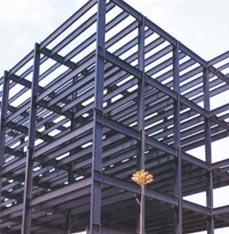
India’s approach to infrastructure is undergoing a pivotal transformation, shifting focus from merely constructing new assets to ensuring the longevity and sustainability of existing ones. This shift is crucial, as the economic implications of infrastructure deterioration can silently diminish the returns on vast public investments.
A recent study conducted by the Nomura Research Institute (NRI) Consulting & Solutions India highlights the magnitude of this issue: corrosion is estimated to cost India’s infrastructure sector a staggering Rs. 1.42 Lakh Crores each year, which represents approximately 2.9% of the sector’s GDP. More notably, NRI suggests that a broader adoption of galvanised steel in infrastructure projects could lead to potential savings of up to Rs. 49,580 Crores annually.
India’s Infrastructure Expansion is Creating a Corrosion Liability
Over the past decade, India has significantly expanded its physical infrastructure. According to the NRI study, between 2015 and 2025:
The national highway network has expanded to approximately 1.46 lakh km
The number of airports has increased from 74 to 157
Port capacity has doubled from roughly 800 MTPA to 1,600 MTPA
Approximately 25,871 km of railway tracks have been added
These figures indicate a major capital investment cycle, but they also highlight an equally important secondary requirement: preserving the installed asset base. Each kilometre of highway, railway, bridge, port, airport, and urban infrastructure utilises significant quantities of steel. When exposed to moisture, oxygen, salts, industrial pollutants, and fluctuating temperatures, corrosion begins to degrade these assets continuously.
This creates a paradox: India is building infrastructure at an unprecedented pace while simultaneously accumulating a substantial future maintenance liability. The Rs. 1.42 Lakh Crores annual corrosion cost should, therefore, be viewed not merely as a maintenance expense but as a potential drag on infrastructure productivity. |
|
|
SAIL and BCCL Forge Key Partnership to Boost Coal Production
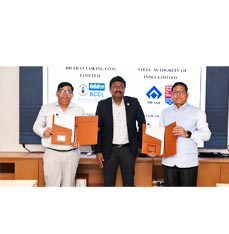
Steel Authority of India Limited (SAIL) has joined forces with Bharat Coking Coal Limited (BCCL), a subsidiary of Coal India, by signing a Memorandum of Understanding (MoU) for the collaborative development and operation of two coal blocks in West Bengal. This strategic move is designed to enhance the availability of raw materials for the domestic steel industry.
The agreement encompasses SAIL’s Indikatta Ramnagore Coal Block alongside BCCL’s East of Damagoria (Kalyaneshwari) Coal Block. Collectively, these blocks boast a peak rated capacity of 4 million tonnes per annum, with Phase I projected to contain around 79 million tonnes of extractable reserves.
Under this integrated mining framework, coal extraction and the management of overburden will be meticulously coordinated between the adjoining blocks. Initially, mining operations in the Kalyaneswari block will see overburden being dumped in the Ramnagar block, with the process reversed in Phase II.
The aim of this MoU is to boost domestic coking coal production and nurture indigenous sources to support India’s steel industry. This initiative aligns with BCCL’s strategy to expand local coking coal availability, thus reducing reliance on imports, which currently account for nearly 90% of India’s metallurgical coal needs. The collaboration marks a vital step towards strengthening raw material security for steel manufacturing in the country.
BCCL operates mines within the Jharia and Raniganj coalfields and possesses the capacity to wash raw coal, transforming it into higher-quality washed coking coal tailored for steel sector customers. Notably, SAIL is already one of BCCL’s major customers, with SAIL, Damodar Valley Corporation, and Uttar Pradesh Rajya Vidyut Utpadan Nigam collectively generating 57.52% of BCCL’s revenue from major clients in FY’26. This new partnership stands to strengthen the existing commercial relationship between these two central public sector enterprises while providing SAIL with increased assurance regarding coking coal supply.
This collaboration follows a challenging fiscal year 2025-26 for BCCL, during which operational revenue dipped to Rs. 13,644.78 Crores from Rs. 15,917.21 Crores the previous year. The proximity of the West Bengal coal blocks to SAIL’s core facilities is expected to yield substantial logistics savings and bolster operating margins in the forthcoming fiscal cycles. |
|
|
Primetals Technologies and Voestalpine Reach Milestone in Austria’s Largest Climate Protection Programme
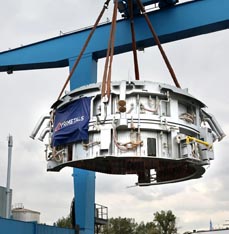
Primetals Technologies and voestalpine have reached an important milestone in the supply and implementation of an EAF Ultimate electric arc furnace at voestalpine’s Linz site in Austria. The milestone was marked by the delivery of several major pieces of core equipment to the site, including the electric arc furnace shell and the transformers weighing approximately 160 tonnes each. The project was awarded to Primetals Technologies in January 2024, while civil and construction work began in late 2024 and is progressing on schedule.
Under its greentec steel strategy, voestalpine is transforming its steel production through a phased approach. The first step involves building one EAF powered by green electricity at each of its Linz and Donawitz sites, aiming to reduce CO2 emissions by 30% by 2029. The emissions reduction corresponds to annual savings of almost 4 MT of CO2, or nearly 5% of Austria’s emissions. This makes greentec steel Austria’s largest climate protection programme.
Powered by green electricity, the EAF at Linz will produce 1.6 MT of steel annually and is scheduled to start up in the first half of 2027. The furnace will have a heat size of 180 tonnes and dimensions of 11 x 9 metres, while the overall construction site measures 100 x 60 x 56 metres in length, width and height.
Primetals Technologies is supplying the complete EAF Ultimate equipment, along with a dedusting system, waste-heat recovery system, power supply solution, and material handling equipment for alloying materials and additives. The order also includes full Level 1 and Level 2 automation and a power supply system featuring a static synchronous compensator (STATCOM) for optimised grid stabilisation. The LiquiRob robotic system is also included as part of the automation solutions aimed at improving efficiency and occupational safety.
The advanced Level 2 automation system will enable enhanced process control and precise calculation of the plant’s carbon footprint.
Paul Pennerstorfer, Head of Upstream Technologies at Primetals Technologies, said strong partnerships and collaboration are critical to the success of green steel transition programmes. He added that the project is progressing as planned, marking important milestones and bringing voestalpine closer to realising its vision of decarbonised steel production. |
|
 |
|
7TH INDIAN STEEL CONFERENCE

16th-17th February 2027
Next Generation Rolling
Technology For
Flat/Galvanised/Coated/Electrical Steel
Conference & Exhibition,
Mumbai
Website: www.isrinfomedia.com |
|
|
 |
|
|